Berlin Neighbourhood Guide
Kreuzberg
Two kiez wearing one name — loud, political 36 to the east, quiet canal-side 61 to the west. The vintage here kept its edge.
The Neighbourhood
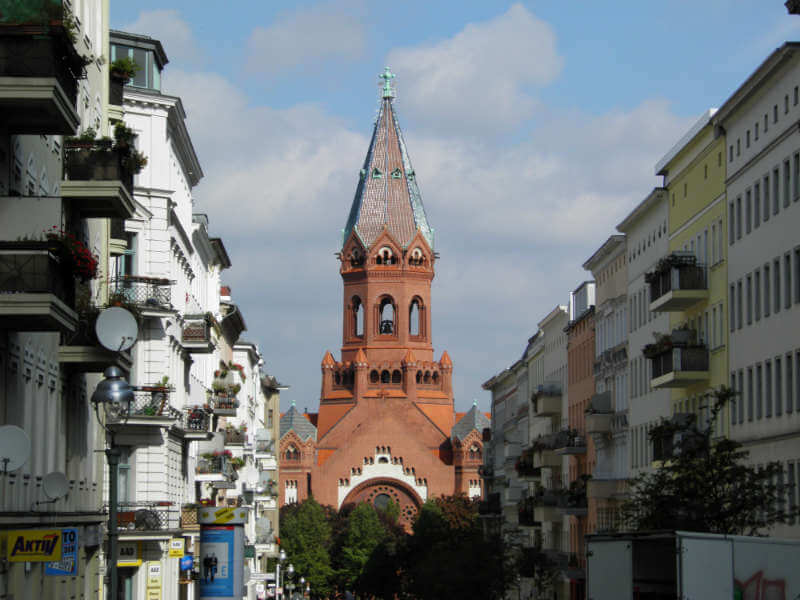
Kreuzberg splits into two very different halves. The eastern end — Kreuzberg 36 — is dense, loud and politically charged, with Turkish grocers, late-night bars and one of Berlin’s most alive street cultures. The western half — Kreuzberg 61 — is quieter, lined with canals and Gründerzeit buildings, and home to some of the city’s best independent shops.
For vintage, the map has two centres of gravity. Bergmannkiez first: the basement shops around Bergmannstrasse hold some of the most organised racks in Berlin, and Mehringdamm adds addresses that reward the detour — including a second hand shop inside a former 1940s cinema. Then the canal: Paul-Lincke-Ufer and the streets off Kottbusser Damm, where the border with Neukölln stops meaning anything and the good shops hide on streets nobody calls shopping streets.
What makes Kreuzberg different is the mix of price levels. You can dig through five-euro bins in 36 and walk twenty minutes to a curated store in 61 where every piece has been chosen twice. Plan a half-day, cross the halves on foot, and let the Landwehrkanal do the navigation.
Where to Shop
Cool Spots in Kreuzberg
Vintage
Dress Code - Vintage Store
Vintage Store in Bergmannkiez
Close to the busy Bergmannstrasse there’s a couple of those typical basement-level shops and one of them is a brilliant vintage and 2nd hand store. Go down a couple of steps and you’re in one of the most organised and curated vintage stores in Berlin.
The racks are neatly divided by colour and type, the clothes well-selected for quality and variety. Dress Code covers all decades from the 60s to the 90s — women and men — with a good eye for what actually works today. There’s a solid accessories section too: hats, belts, bags, jewellery.
The prices are fair and the selection is regularly refreshed. One of the few Kreuzberg vintage shops where you can actually find what you’re looking for without digging for an hour.
Vintage
Checkpoint u. Cinema
Second hand inside the former Prisma Kino, Mehringdamm
From outside, it looks like any other second hand shop on Mehringdamm. Then you look up at the facade and you see it — a fresco, with “Cinema” written across it. This was the Prisma Kino, which ran from 1949 to 1977. You walk in past shoes and old party dresses, then step into the actual screening hall — big curtains at the back, ornate molding on the ceiling.
The racks live up to the room. Mainly men’s and unisex vintage from the 70s through 90s — good leather jackets, interesting outerwear, a solid accessories section — plus film posters and collectibles that explain the name. Thirty-plus years of Berlin thrifting, huge choice, reasonable prices, and an owner who knows exactly what they’re selling and why.
One of the reasons Kreuzberg 61 keeps its reputation. Go for the racks, stay for the ceiling.
Kids Second-Hand
Rosenrot
Children’s second-hand on beautiful Lausitzer Platz
Rosenrot is a second-hand shop for kids, well-placed on one of Kreuzberg’s nicest squares. You’ll find clothing, shoes and toys across all brands — a practical and sustainable stop if you’re shopping for little ones in the neighbourhood.
Practical Tips
Best Time to Visit
Most shops here open around 11 or noon, and Bergmannstrasse fills up fast on Saturdays. Weekday afternoons are the calm window.
Getting There
U7 to Gneisenaustrasse or Mehringdamm for the Bergmannkiez; U1 to Görlitzer Bahnhof or U8 to Kottbusser Tor for the eastern half.
Local Tips
Do Bergmannstrasse and its basement shops first, then walk down to the canal. Paul-Lincke-Ufer is technically the border with Neukölln — the shops don’t care, and neither should you.
Explore More Neighbourhoods
Berlin has more to discover — from Mitte to Prenzlauer Berg, each neighbourhood has its own vintage scene.